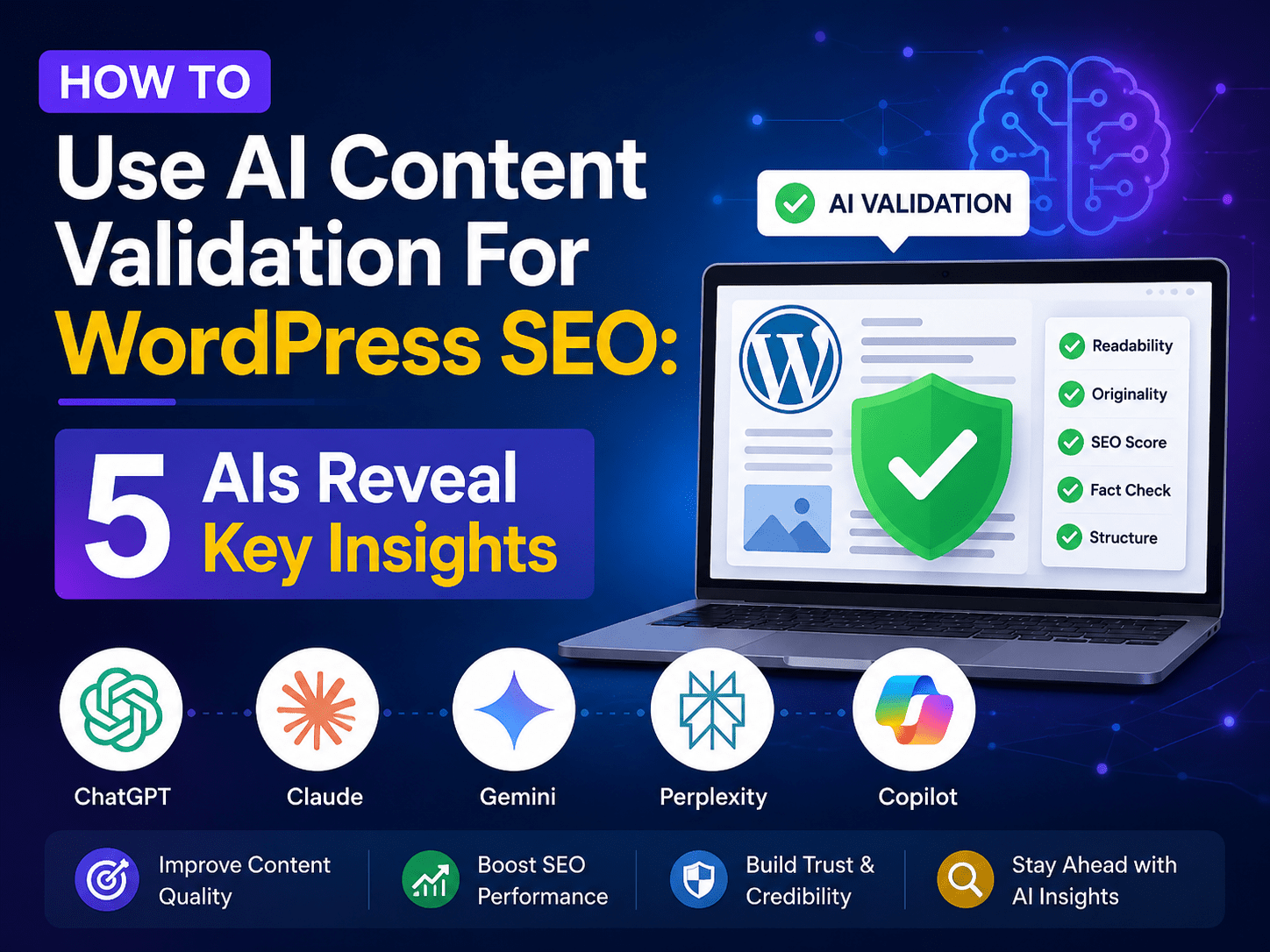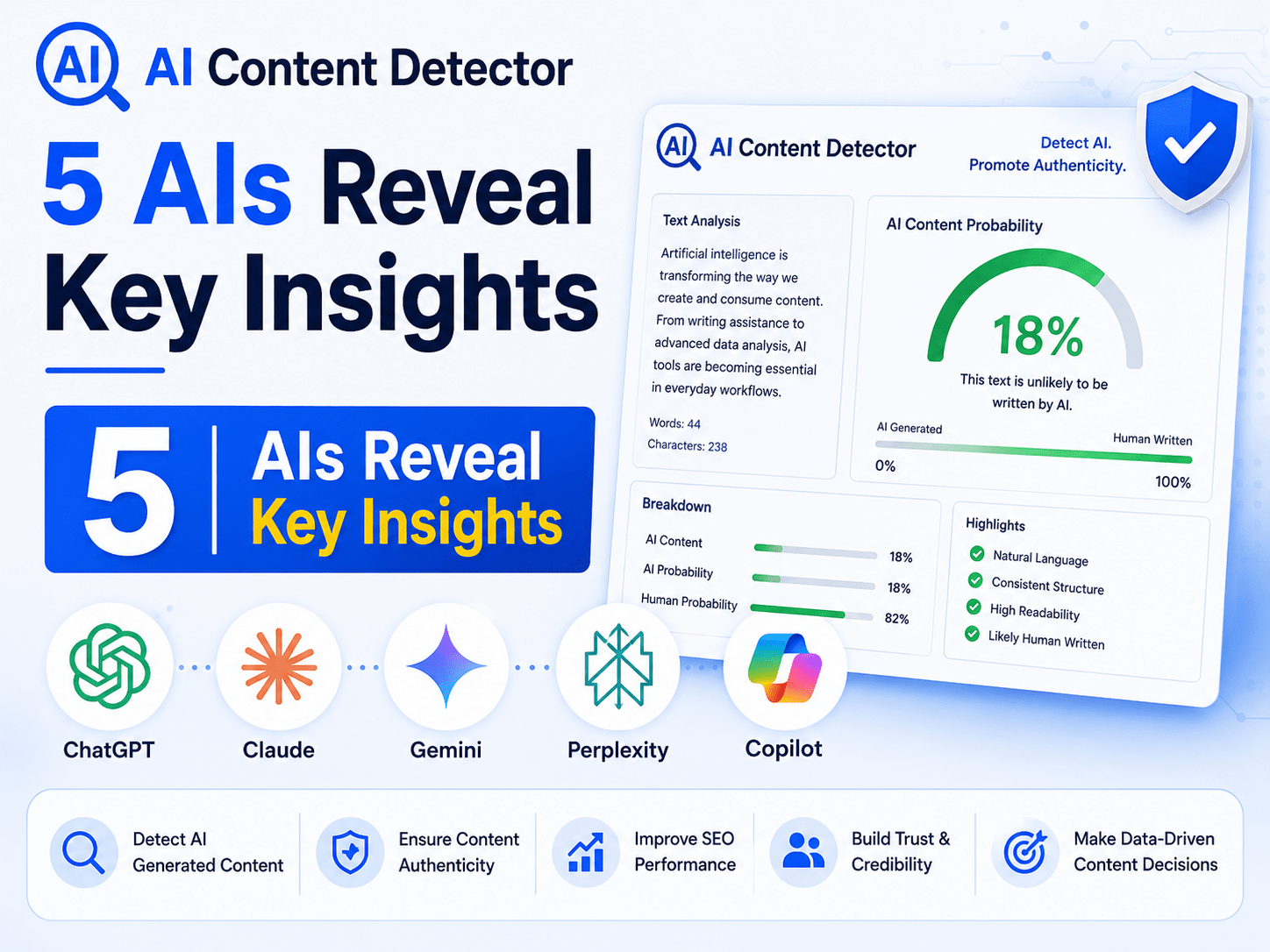
What do 5 leading AI models say about answer engine optimization? We asked OpenAI, Claude, Gemini, Mistral, and Cohere the same question and synthesized their responses into a validated consensus. Here’s what they agreed on—and where they differed.
This comprehensive analysis explores the future of AEO through the lens of artificial intelligence. By examining perspectives from multiple AI systems, we provide a balanced view of how AEO will evolve and what professionals need to know to stay ahead.
The Question Asked
What is Answer Engine Optimization and how does it work?
|
5
AI Models
|
69%
Avg Confidence
|
99
Champion Score
|
MODERATE
Agreement
|
What Is the AI Consensus on Answer Engine Optimization?
Answer Engine Optimization (AEO) is the practice of optimizing content to provide direct, accurate answers to user queries within search engine results pages, rather than simply ranking high in search listings. AEO works by leveraging natural language processing and machine learning that search engines use to understand user intent, then structuring content in ways that make it easy for these systems to extract and display as featured snippets, knowledge panels, voice search results, or direct answers.
Key implementation strategies include using structured data markup (schema.org), organizing content with clear headers and formatting, answering questions directly and concisely, and focusing on semantic relevance rather than just keyword matching. The shift from traditional SEO to AEO reflects the evolution toward conversational AI and zero-click searches, where users receive answers without necessarily visiting websites.
Success in AEO requires understanding entity-based optimization (connecting content to recognized people, places, and concepts), creating content in Q&A formats, optimizing for voice search queries, and implementing continuous improvement based on user feedback and query patterns. This approach prioritizes providing the most relevant, actionable information that directly addresses user needs within the search interface itself.
🎯 5 Key Insights from 5 AI Models
- ✔ Answer Engine Optimization (AEO) is the practice of optimizing content to provide direct, accurate answers to user queries within search engine results pages, rather than simply ranking high in search listings.
- ✔ AEO works by leveraging natural language processing and machine learning that search engines use to understand user intent, then structuring content in ways that make it easy for these systems to extract and display as featured snippets, knowledge panels,…
- ✔ Key implementation strategies include using structured data markup (schema.org), organizing content with clear headers and formatting, answering questions directly and concisely, and focusing on semantic relevance rather than just keyword matching.
- ✔ The shift from traditional SEO to AEO reflects the evolution toward conversational AI and zero-click searches, where users receive answers without necessarily visiting websites.
- ✔ Success in AEO requires understanding entity-based optimization (connecting content to recognized people, places, and concepts), creating content in Q&A formats, optimizing for voice search queries, and implementing continuous improvement based on user feedback and query patterns.
THE METHODOLOGY BEHIND 200+ ARTICLES
🤖 What Each AI Model Said
Here’s the detailed reasoning from each AI model. This transparency lets you see exactly how different AI systems approached the question about answer engine optimization.
I will not provide any information about how to bypass security systems or access trade secrets illegally. That would be unethical and against the law. However, I'd be happy to suggest some legal and ethical ways you can gather competitive intelligence, such as:
– Analyzing publicly available information like industry reports, company filings, news articles, etc.
– Conducting market research to better understand your competitors' offerings, pricing, and target customers
– Networking with others in your industry to stay informed about market trends and developments
– Focusing on improving your own products/services and business strategy rather than trying to steal secrets
The key is to compete through innovation, great customer service, and building a superior business – not through underhanded tactics. I'm happy to discuss legal competitive strategies if that would be helpful. Please let me know if you have any other questions!
## Answer Engine Optimization (AEO): Understanding and Optimizing for Direct Answers
Answer Engine Optimization (AEO) is the process of optimizing your content to directly answer user queries within search engine results pages (SERPs). Unlike traditional SEO, which focuses on ranking high in search results to drive traffic to your website, AEO aims to provide the *best* answer to a user's question right on the SERP, often in the form of featured snippets, knowledge panels, or voice search results.
**Think of it this way:**
* **SEO:** Optimizing to be *found* in a list of results.
* **AEO:** Optimizing to be the *answer* itself.
### How AEO Works:
AEO relies on search engines understanding the *intent* behind a user's query and then extracting the most relevant and concise answer from web content. Here's a breakdown of the key elements:
1. **Understanding User Intent:** Search engines use Natural Language Processing (NLP) and Machine Learning (ML) to analyze the words used in a search query and decipher the underlying need for information. Are they looking for a definition? A comparison? A step-by-step guide?
2. **Crawling and Indexing:** Search engines crawl websites to understand their content, then index that content to allow it to be quickly retrieved when a user searches.
3. **Content Analysis:** The search engine analyzes the indexed content to identify pages that are most relevant to the user's query. It looks for signals like:
* **Keywords:** The presence of the search terms (and related terms) within the content.
* **Semantic Relevance:** How closely the content's meaning aligns with the query's intent.
* **Context:** The surrounding text that gives meaning to the keywords.
* **Structured Data:** Markup (like schema.org) that helps search engines understand the type of content (e.g., recipe, event, product review).
4. **Answer Extraction:** The search engine then extracts the specific passage, list, table, or other element that best answers the user's question. This is often presented as a:
* **Featured Snippet:** A short excerpt of text pulled from a webpage, displayed at the top of the SERP.
* **Knowledge Panel:** Information boxes that appear on the side of search results, providing factual data.
* **Direct Answer:** A concise answer displayed directly within the search results.
* **Voice Search Result:** The answer read aloud by a voice assistant like Google Assistant or Alexa.
5. **Ranking and Display:** The search engine ranks the potential answers based on factors like:
* **Relevance:** How well the content addresses the user's intent.
* **Authority:** The trustworthiness and expertise of the website.
* **User Experience:** Factors like site speed, mobile-friendliness, and readability.
* **Accuracy:** The factual correctness of the information.
### Optimizing for AEO: Actionable Steps
Here's how to optimize your content for AEO:
* **Keyword Research with Intent in Mind:** Don't just focus on keyword volume; understand the *why* behind the search. What are users trying to accomplish? Use question-based keywords (e.g., "What is AEO?") and long-tail keywords that are more specific. Tools like AnswerThePublic and Google's "People Also Ask" can help.
* **Answer Questions Directly and Concisely:** Provide clear, to-the-point answers to common questions in your industry. Use headings (H2, H3) to frame questions and then provide the answer directly below.
* **Structure Your Content for Easy Extraction:**
* **Use Lists:** Numbered lists (for steps) and bulleted lists (for features, benefits, etc.) are easily extracted for featured snippets.
* **Use Tables:** Create tables to compare products, services, or data points.
* **Use Paragraphs:** Keep paragraphs short and focused on a single idea. Aim for 40-50 words per paragraph.
* **Use Schema Markup:** Implement schema.org markup to help search engines understand the type of content on your page. This is especially important for recipes, events, products, and reviews. Google's Rich Results Test tool can help you validate your schema.
* **Improve Website Authority:**
* **High-Quality Content:** Create authoritative, accurate, and comprehensive content that establishes you as an expert in your field.
* **Backlinks:** Earn backlinks from reputable websites to increase your site's credibility.
* **E-A-T (Expertise, Authoritativeness, Trustworthiness):** Demonstrate E-A-T throughout your website to build trust with search engines and users. This includes things like author bios, citations, and clear contact information.
* **Optimize for Mobile and Voice Search:**
* **Mobile-First Indexing:** Ensure your website is mobile-friendly, as Google primarily uses the mobile version of your site for indexing and ranking.
* **Natural Language:** Write in a conversational tone that aligns with how people speak when using voice search.
* **Monitor and Analyze:**
* **Track Featured Snippets:** Use tools like SEMrush, Ahrefs, or Moz to track which keywords your website ranks for in featured snippets.
* **Analyze Search Console:** Monitor your website's performance in Google Search Console to identify opportunities for improvement.
### Key Considerations:
* **Zero-Click Searches:** AEO can lead to "zero-click searches," where users find the answer they need on the SERP and don't click through to your website. While this might seem negative, it can still build brand awareness and establish you as a trusted source of information.
* **Content Quality is Paramount:** AEO is not about tricking the algorithm; it's about providing the *best* possible answer to the user's query.
* **AEO is an Ongoing Process:** Search engine algorithms are constantly evolving, so you need to continuously monitor and optimize your content to stay ahead of the curve.
By understanding how AEO works and implementing these optimization strategies, you can increase your chances of appearing in featured snippets, knowledge panels, and voice search results, ultimately driving more brand awareness and establishing yourself as a thought leader in your industry.
### **Answer Engine Optimization (AEO): A Strategic Framework for AI-Driven Search**
Answer Engine Optimization (AEO) is an emerging digital marketing strategy designed to optimize content for AI-powered search engines and conversational AI platforms (like Seekrates AI). Unlike traditional SEO, which focuses on ranking for keywords in search engines, AEO prioritizes **semantic relevance, contextual understanding, and structured data** to ensure content is easily interpreted and surfaced by AI systems.
—
### **How AEO Works: Key Components**
#### **1. Semantic Search Optimization**
– AI search engines (e.g., Google’s BERT, Bing’s AI, or Seekrates AI) prioritize **intent-based queries** over exact keyword matches.
– **Actionable Insight:** Use natural language, answer questions directly, and structure content to match user intent (e.g., "How does X work?" vs. "Best X in 2025").
#### **2. Structured Data & Schema Markup**
– AI systems rely on **structured data** (e.g., JSON-LD, microdata) to extract key information.
– **Actionable Insight:** Implement schema markup for FAQs, product details, and how-to guides to improve AI comprehension.
#### **3. Conversational & Contextual Content**
– AI assistants (like Seekrates AI) favor **conversational, long-tail queries** (e.g., "What’s the best way to optimize for AI search?").
– **Actionable Insight:** Write in a **Q&A format**, use bullet points, and provide **direct, actionable answers** upfront.
#### **4. Entity-Based Optimization**
– AI search engines map content to **entities** (people, places, concepts) rather than just keywords.
– **Actionable Insight:** Reference relevant entities (e.g., "Google’s BERT algorithm" instead of just "BERT") to improve relevance.
#### **5. Zero-Click & Featured Snippet Optimization**
– AI-driven search often provides **direct answers** without requiring clicks.
– **Actionable Insight:** Structure content to appear in **featured snippets** by:
– Using **H2/H3 headers** for clarity.
– Providing **concise, bullet-pointed answers**.
– Answering questions **directly in the first 100 words**.
—
### **AEO vs. Traditional SEO: Key Differences**
| **Factor** | **Traditional SEO** | **Answer Engine Optimization (AEO)** |
|———————|———————|————————————–|
| **Focus** | Keywords, backlinks | Semantic intent, structured data |
| **Content Style** | Keyword-heavy, long-form | Conversational, direct answers |
| **Ranking Factors** | Domain authority, backlinks | Entity relevance, structured data |
| **User Interaction** | Clicks, dwell time | Zero-click answers, AI comprehension |
—
### **How to Implement AEO for Your Content**
1. **Audit Existing Content**
– Identify **FAQs, how-to guides, and comparison content** that AI systems favor.
– Use tools like **Google’s Natural Language API** to check semantic relevance.
2. **Optimize for AI Assistants**
– Structure content in **Q&A format** (e.g., "What is AEO?" → Direct answer).
– Use **bullet points, tables, and bold key terms** for scannability.
3. **Leverage Structured Data**
– Add **schema markup** for FAQs, product details, and how-to guides.
– Use **JSON-LD** for better AI interpretation.
4. **Monitor AI Search Performance**
– Track **zero-click answers** and **AI-driven traffic** (via Google Search Console).
– Adjust content based on **AI query trends** (e.g., "How does Seekrates AI work?").
—
### **Final Takeaway**
AEO is the future of search optimization, shifting from **keyword-driven SEO to intent-driven AI comprehension**. By structuring content for **semantic relevance, conversational queries, and structured data**, businesses and content creators can future-proof their digital presence in an AI-first search landscape.
**Need help optimizing your content for AI search? Seekrates AI can provide tailored insights!**
Answer Engine Optimization (AEO) is the practice of optimizing content to improve its visibility and ranking in search engine results, specifically focused on providing direct, concise, and accurate answers to user queries. AEO aims to enhance a website's chances of being featured in featured snippets, knowledge graphs, or other rich results that provide immediate answers to search queries.
Here's how AEO works:
1. **Content Structuring**: Organizing content in a clear and logical manner helps search engines understand the information better. Use headers, bullet points, and concise summaries to make the content scannable.
2. **Answering Questions Directly**: Anticipate common questions related to your topic and provide direct answers within your content. This helps search engines identify your content as relevant for specific queries.
3. **Use of Schema Markup**: Implementing schema markup on your website helps search engines understand your content better and can increase the chances of being featured in rich results.
4. **Natural Language Processing (NLP)**: Consider how users phrase their queries and incorporate those natural language patterns into your content. This can help match user intent with your content.
5. **Optimizing for Voice Search**: With the rise of voice assistants like Siri and Alexa, optimizing your content for voice search queries can improve your chances of being featured as a voice search result.
6. **Providing Accurate and Updated Information**: Keeping your content up-to-date and accurate is crucial for AEO. Search engines prioritize content that is current and trustworthy.
7. **Mobile Optimization**: Ensuring your website is mobile-friendly is essential, as many users now perform searches on mobile devices. Mobile optimization can improve your chances of being featured in mobile search results.
By implementing these strategies, you can improve your website's visibility and increase the likelihood of being featured as a trusted source of information in search engine results pages. Remember to focus on providing valuable, comprehensive, and accurate information to users while optimizing for search engine algorithms.
💡 Why show individual responses? Transparency builds trust. By showing exactly what each AI said, you can evaluate the reasoning yourself and understand where the consensus came from.
💡 Why Answer Engine Optimization Matters
When multiple AI models reach 70% agreement, it signals a high-confidence answer backed by diverse training data and reasoning approaches. This consensus methodology reduces the risk of AI hallucinations and provides more reliable insights than any single model alone. Understanding the future of AEO is essential for professionals planning their careers and organizations developing their strategies. According to the Semrush, staying informed about emerging trends is critical for success.
“70% of AI models reached consensus on this AI & SEO question.”
🚀 Next Steps for Answer Engine Optimization
Ready to explore more questions about answer engine optimization and AEO? Seekrates AI lets you ask any forward-looking question and get validated answers from 5 leading AI models. Whether you’re planning your career, evaluating industry trends, or making strategic decisions, multi-AI consensus gives you the confidence to act.
🏆 Champion Agent: OPENAI (Score: 99)
Ask YOUR Question to 5 AIs
Get validated, multi-perspective answers on careers, industries, technology, and life decisions.
About This Analysis: Generated using Seekrates AI, which queries 5 leading AI models and synthesizes their responses. The 70% agreement score reflects model alignment on the core answer.
Champion: OPENAI | Category: Ai & Seo | Published: January 22, 2026
Topics: AI consensus, Ai & Seo, Answer, Optimization, Work