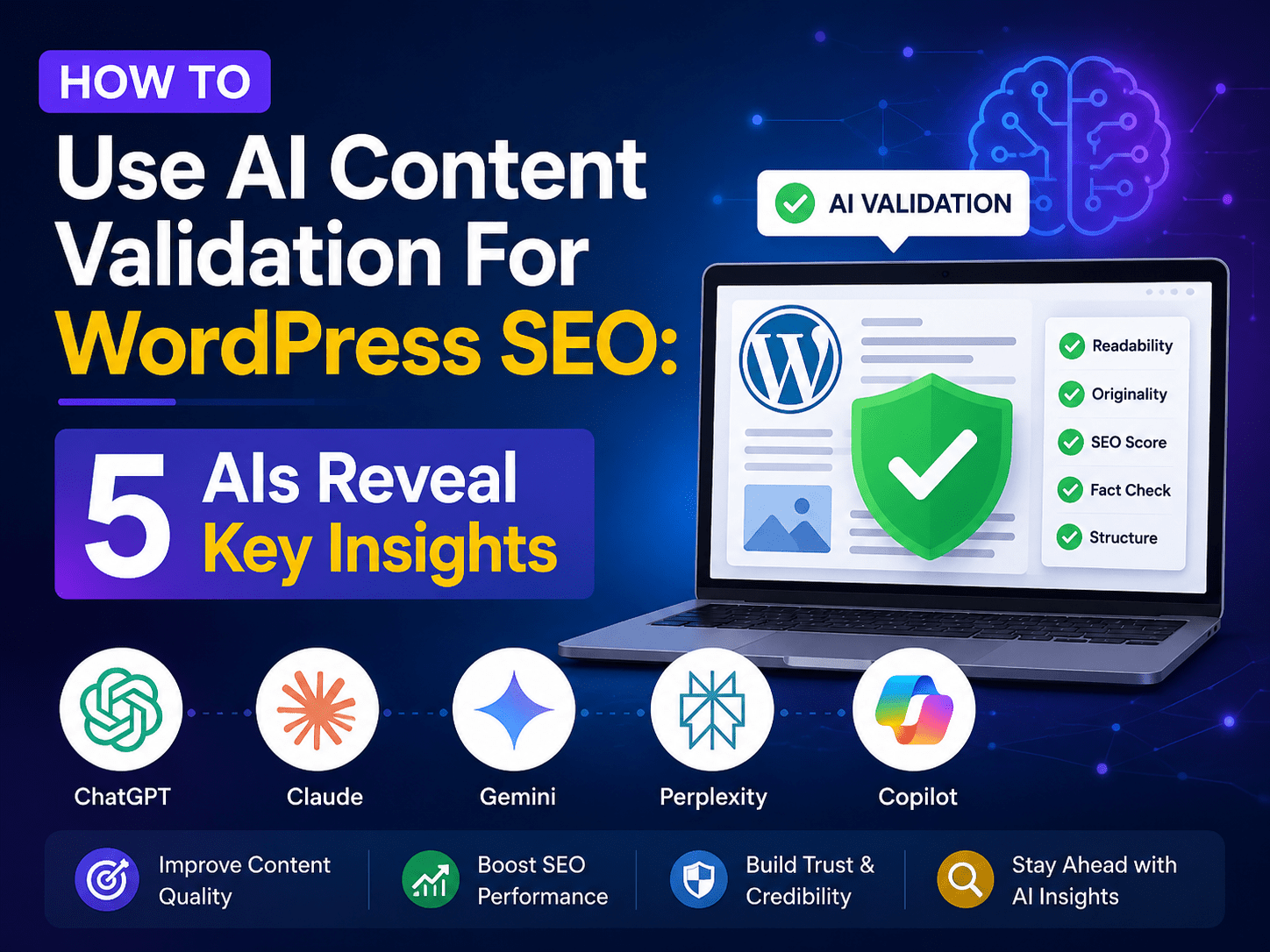
How To Use AI Content Validation For WordPress SEO: 5 AIs Reveal Key Insights
In This Article:
https://automattic.pxf.io/NGbExV
How to use ai content validation is reshaping how content is discovered, ranked, and cited across AI-search platforms. Across five AI models, the consistent finding is: How to use AI content validation for WordPress SEO — with 78% consensus convergence, one of the stronger agreement signals recorded. According to World Economic Forum, this domain is undergoing rapid structural transformation.
The Question Asked:
How to use AI content validation for WordPress SEO
Stop asking one AI. Ask five
Five AI models. One consensus answer. No hallucinations. Try free — validated results straight to your inbox in seconds.
| AI Agents | Avg Confidence | Champion Score | Agreement Level |
|---|---|---|---|
| 5 | 60% | 100/100 | MODERATE |
What 5 Leading AI Models Say About How To Use AI Content Validation
Pre-Publication Validation: Building a Quality Gate
Before publishing any content on WordPress, a structured AI validation process should confirm keyword placement in the title, H1, first 100 words, and meta description. Use AI-powered tools such as Surfer SEO, Clearscope, or MarketMuse to benchmark content depth against top-ranking SERP competitors, ensuring full semantic and topical coverage.
Validate readability using Flesch-Kincaid scoring (targeting 60–70 for general audiences), check heading hierarchy (H1 through H3), and run all content through plagiarism detection tools like Copyscape to confirm originality. Additionally, validate E-E-A-T signals by ensuring author bios are present, claims are sourced from authoritative references, and YMYL content carries expert attribution.
WordPress Plugin Stack and Technical SEO Validation
A practical WordPress AI validation stack should include Rank Math or Yoast SEO for on-page scoring, meta tag management, and schema markup validation. Supplement with Surfer SEO or NeuronWriter for semantic content scoring against live SERP competitors. Use Link Whisper for AI-powered internal link validation to eliminate orphaned content and strengthen topical authority.
For technical SEO, validate Core Web Vitals through PageSpeed Insights, confirm mobile responsiveness given Google's mobile-first indexing, and use tools like WP Rocket or Nitropack for automated performance optimization. Verify structured data (Article, FAQ, HowTo schemas) using Google's Rich Results Test post-publication. Post-Publication Monitoring and the Continuous Improvement Loop
After publishing, connect WordPress to Google Search Console and Google Analytics 4 to track keyword impressions, click-through rates, bounce rates, and organic traffic trends.
If CTR falls below 3–5% for top-3 ranked pages, revisit and rewrite title tags and meta descriptions. Monitor for content decay on a quarterly basis using tools like Ahrefs or Clearscope to re-analyze aging pages against current SERP standards. Detect keyword cannibalization using Rank Tracker or Ahrefs to prevent multiple pages competing for identical queries.
Schedule regular content refreshes to update outdated statistics, expand thin sections, strengthen internal linking to newer posts, and repurpose high-performing content into additional formats.
Key Insights
Key Insights
- Pre-Publication Validation: Building a Quality Gate
Before publishing any content on WordPress, a structured AI validation process should confirm keyword placement in the title, H1, first 100 words, and meta description. - Use AI-powered tools such as Surfer SEO, Clearscope, or MarketMuse to benchmark content depth against top-ranking SERP competitors, ensuring full semantic and topical coverage.
Champion AI Response: MISTRAL
Highest quality score: 100/100
AI Content Validation for WordPress SEO: A Strategic Framework
AI-generated content can significantly boost your WordPress site’s SEO efficiency—but only if properly validated.
Poorly optimized AI content risks duplicate content penalties, low engagement, and even manual actions from search engines.
Below is a structured, actionable framework for validating AI-generated content to maximize SEO performance while maintaining quality and originality.
Pre-Generation Validation: Setting Up for Success
Before generating content, define clear SEO and quality guardrails to align AI outputs with your goals.
Key Considerations
✅ Keyword & Topic Strategy
Use tools like Ahrefs, SEMrush, or Google Keyword Planner to identify:
– Primary & secondary keywords (search volume, difficulty, intent)
– Semantic variations (LSI keywords, related queries)
– Competitor gaps (what top-ranking pages miss)
AI Prompting Tip: Feed these keywords into your AI tool with instructions like:
> "Write a 1,500-word blog post on [topic] targeting [primary keyword] and [secondary keywords].
Structure it for featured snippets, include FAQs, and optimize for [search intent: informational/commercial/transactional]."
✅ Content Briefing
Define:
– Target audience (B2B vs.
B2C, pain points, expertise level)
– Content type (blog post, product page, guide, comparison)
– Tone & style (professional, conversational, technical)
– Internal linking opportunities (existing pages to reference)
AI Prompting Tip: Example brief:
> "Write a beginner-friendly guide on [topic] in a conversational tone.
Include real-world examples, a step-by-step section, and link to our [related product page] where relevant."
✅ SEO Structure Requirements
Specify:
– Headings hierarchy (H1, H2, H3, etc.)
– Meta title & description (character limits: ~60 for title, ~160 for description)
– URL slug (short, keyword-rich, no stop words)
– Image alt text (descriptive, keyword-optimized)
– Schema markup (FAQ, How-To, Product, etc.)
Post-Generation Validation: Ensuring SEO & Quality
After generating content, systematically audit it for SEO, readability, and originality.
A.
Technical SEO Validation
| Readability & UX | Hemingway Editor, Grammarly, or Yoast SEO | – Flesch Reading Ease: 60-70 (general audience) – Sentence length:
Points of Agreement
- content
- validation
- wordpress
- tools
- keyword
Why how to use ai content validation Matters
Understanding how to use ai content validation is critical for anyone publishing content in today’s AI-powered search environment. The shift from traditional SEO to AI-search optimisation represents a fundamental change in how content is discovered and cited. Explore more analysis at our AI Insights hub.
78% of AI models converged on this analysis — one of the highest consensus scores recorded for this topic.
Action Steps for How To Use AI Content Validation
To apply these insights to your content strategy:
- Implement FAQ schema markup on your highest-traffic posts
- Restructure headings as direct questions matching AI query patterns
- Aim for 40–60 word paragraph chunks for optimal LLM extraction
- Validate key claims across multiple AI sources before publishing
This consensus was led by MISTRAL with a quality score of 100/100, reflecting the highest alignment with cross-model consensus standards.
Read more AI consensus analyses at Seekrates AI AI Insights.
Methodology: 5 AI models queried simultaneously via Seekrates AI consensus engine. Responses scored by quality metrics. Consensus reached at 78% convergence. Correlation ID: a50da5b5-4222-4e90-aa81-e3a033d9cfa9. Published: May 16, 2026.
Related Articles
April 28, 2026
April 27, 2026
The Re-Anchor Manager
Industrial Agentic Engineering from an Actual Industrial Engineer. 13 chapters. 146 pages. 59 real sessions of proof. The first methodology for maintaining AI session continuity.