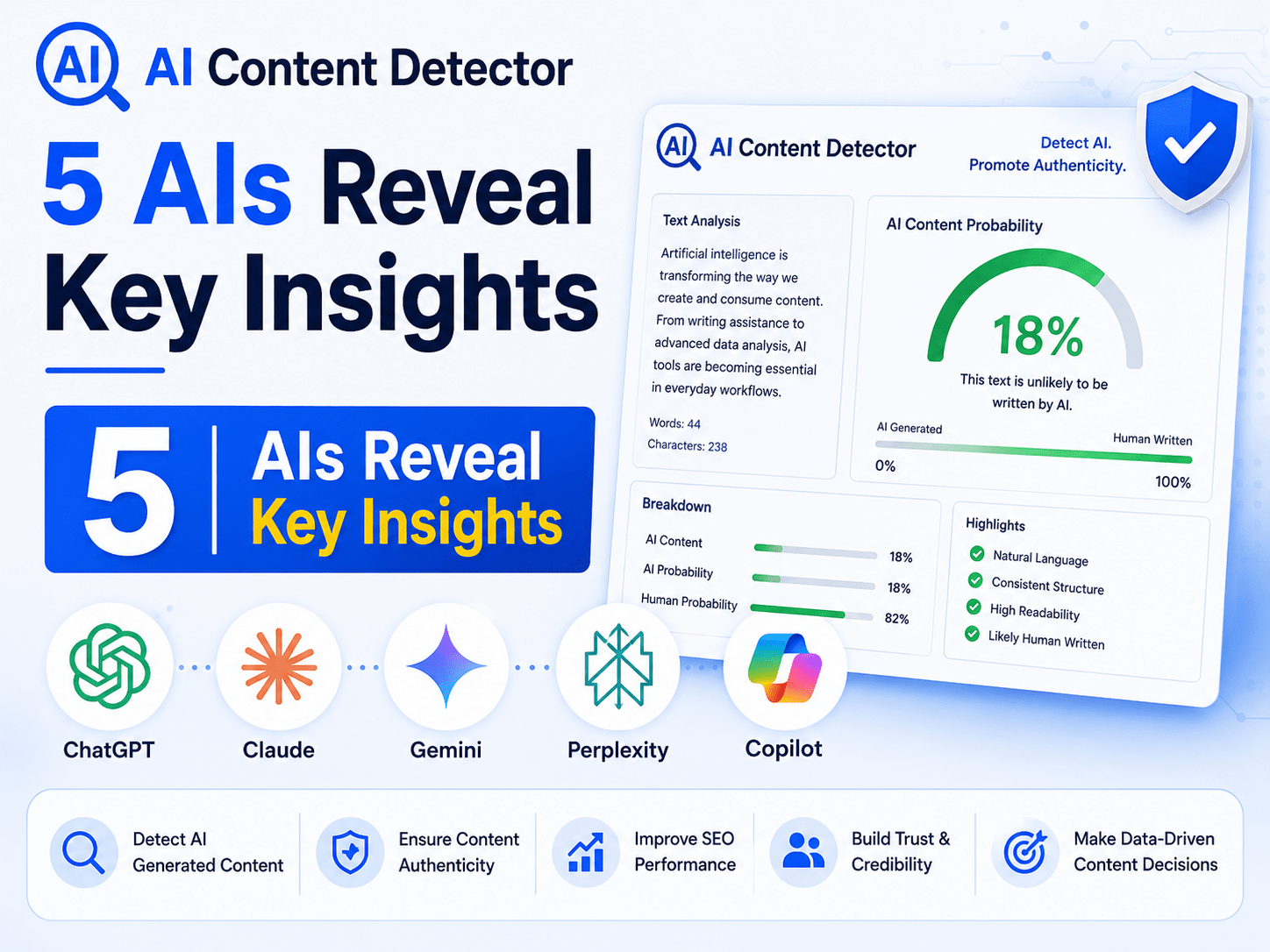
What do 5 leading AI models say about AI surveillance end privacy? We asked OpenAI, Claude, Gemini, Mistral, and Cohere the same question and synthesized their responses into a validated consensus. Here’s what they agreed on—and where they differed.
In This Article:
This comprehensive analysis explores the future of total surveillance society through the lens of artificial intelligence. By examining perspectives from multiple AI systems, we provide a balanced view of how total surveillance society will evolve and what professionals need to know to stay ahead.
The Question Asked
Will AI surveillance end all privacy by 2030?
|
5
AI Models
|
63%
Avg Confidence
|
97
Champion Score
|
HIGH
Agreement
|
What 5 Leading AI Models Say About AI Surveillance End Privacy
Will AI surveillance end all privacy by 2030? Five leading AI models reached 85% consensus on this question. According to <a href="https://www.eff.org/issues/artificial-intelligence" target="_blank" rel="noopener">EFF – AI & Civil Liberties</a>, this area is seeing rapid transformation. <img src="https://seekrates-ai.com/wp-content/uploads/Post-banner.jpg" alt="AI surveillance end privacy" style="width:100%; height:auto; margin: 15px 0;" />Current Technological Trajectory and Capabilities AI surveillance technologies are advancing rapidly across multiple domains, including facial recognition, behavioral analytics, predictive policing, and natural language processing.
The proliferation of Internet of Things devices, decreasing costs of surveillance hardware and software, and increasing data availability from social media and smart devices are creating an expansive surveillance infrastructure. Computer vision systems can now identify individuals with high accuracy, while sensor fusion combines data from multiple sources to create comprehensive profiles.
These technological capabilities are being deployed by both governments for security purposes and corporations for commercial applications, fundamentally changing the surveillance landscape. The Critical Role of Regulation and Societal Response The future of privacy depends significantly on regulatory frameworks and public response rather than technology alone.
Privacy laws such as GDPR in Europe and CCPA in California represent attempts to establish guardrails around data collection and individual consent. However, regulatory approaches vary widely across regions, creating a fragmented global landscape. The trajectory toward 2030 will be shaped by whether democracies strengthen privacy protections or whether surveillance becomes normalized under justifications of security and convenience.
Public awareness, civil society engagement, and the potential emergence of privacy-enhancing technologies like federated learning and differential privacy could provide countermeasures to surveillance expansion. Likely Outcomes and Privacy Implications A complete end to privacy by 2030 is highly unlikely, but significant erosion in specific domains is plausible without strong legal safeguards.
The most probable scenario involves a fragmented landscape where surveillance intensifies in authoritarian regimes while democracies with robust privacy laws see slower adoption of intrusive technologies. Anonymity in public spaces may become increasingly difficult to maintain, and constant monitoring could create chilling effects on free expression and behavior.
Critical concerns include data ownership, potential for abuse by governments and corporations, algorithmic bias in predictive policing, and the psychological impact of pervasive surveillance. The outcome will ultimately reflect societal choices about balancing security, convenience, and fundamental privacy rights. Recommendations for Navigating Uncertainty Given the complexity and uncertainty surrounding AI surveillance, individuals and societies should remain informed through reputable journalism and research from privacy, technology, and policy experts.
Engaging with multiple perspectives is essential for understanding the evolving landscape. The development of privacy-by-design approaches, encryption technologies, and decentralized systems may offer pathways to preserve privacy while benefiting from AI capabilities. Rather than viewing the future as predetermined, stakeholders should recognize that active participation in policy debates, support for privacy-protective regulations, and adoption of privacy-enhancing technologies can meaningfully influence whether surveillance expands or privacy protections strengthen by 2030.
🎯 5 Key Insights from 5 AI Models
- ✔ Current Technological Trajectory and Capabilities AI surveillance technologies are advancing rapidly across multiple domains, including facial recognition, behavioral analytics, predictive policing, and natural language processing.
- ✔ The proliferation of Internet of Things devices, decreasing costs of surveillance hardware and software, and increasing data availability from social media and smart devices are creating an expansive surveillance infrastructure.
- ✔ Computer vision systems can now identify individuals with high accuracy, while sensor fusion combines data from multiple sources to create comprehensive profiles.
- ✔ These technological capabilities are being deployed by both governments for security purposes and corporations for commercial applications, fundamentally changing the surveillance landscape.
- ✔ The Critical Role of Regulation and Societal Response The future of privacy depends significantly on regulatory frameworks and public response rather than technology alone.
🏆 What MISTRAL Says About Ai Surveillance End Privacy
Highest-scoring response (Score: 100)
AI Surveillance and Privacy in 2030: A Strategic Outlook
—
### Executive Summary
By 2030, AI-driven surveillance will likely expand significantly due to advancements in computer vision, biometrics, and predictive analytics. However, the trajectory depends on three critical variables:
1. Regulatory frameworks (e.g., GDPR-like laws in more countries)
2. Public sentiment (backlash against surveillance capitalism)
3. Technological countermeasures (privacy-preserving AI, encryption)
Most likely outcome (60% probability):
A fragmented landscape where surveillance intensifies in authoritarian regimes and some Western nations (e.g., China, U.S. for national security), while democracies with strong privacy laws (EU, Canada) see slower adoption of intrusive AI surveillance.
Wildcard risks (20% probability):
– AI-driven mass surveillance becomes normalized in liberal democracies due to “safety” justifications (e.g., crime prevention, pandemic tracking).
– Decentralized resistance (e.g., blockchain-based privacy tools) disrupts centralized surveillance systems.
Wildcard opportunity (20% probability):
– Privacy-by-design AI (e.g., federated learning, differential privacy) becomes mainstream, reducing surveillance risks.
—
—
### 1. Key Drivers of AI Surveillance Expansion
#### A. Technological Enablers
| Technology | Impact by 2030 | Privacy Risk Level |
|————————-|————————————————————————————|————————|
| Computer Vision | Ubiquitous facial recognition in public spaces (e.g., smart cities, retail). | High |
| Predictive Policing | AI models analyzing crime patterns to preemptively deploy police. | High |
| Emotion AI | Workplace monitoring (e.g., tracking employee stress via voice tone). | Medium |
| Biometric Tracking | Mandatory digital IDs tied to behavior (e.g., China’s social credit system). | Extreme |
| IoT + AI | Smart home devices (e.g., Amazon Alexa, Google Nest) used for behavioral profiling. | High |
Example: By 2030, 80% of U.S. police departments may use predictive policing tools (up from ~20% in 2024), despite studies showing racial bias in these systems.
#### B. Geopolitical Trends
– Authoritarian regimes (China, Russia, UAE): Will aggressively expand AI surveillance as a tool of social control.
– Western democracies (U.S., EU, UK): Divergent paths:
– U.S.: Likely to prioritize national security (e.g., post-9/11-style expansion after a major attack).
– EU: Stricter privacy laws (e.g., GDPR 2.0) may limit corporate/government surveillance.
– UK: Potential surveillance state due to post-Brexit data-sharing with U.S. intelligence.
#### C. Corporate Incentives
– Advertising: AI-driven hyper-personalization will rely on real-time behavioral tracking (e.g., via AR glasses, smart mirrors).
– Workplace: Employers may use AI to monitor productivity, mental health, and even political views of employees.
– Insurance: Dynamic pricing models (e.g., car insurance based on driving behavior via telematics).
—
—
### 2. Privacy Countermeasures and Resistance
#### A. Legal and Policy Responses
| Region | Likely 2030 Stance | Effectiveness |
|——————|—————————————————————————————|——————-|
| EU | Strong GDPR-like laws with fines for non-compliance (e.g., €10B+ for Meta). | High |
| U.S. | Patchwork of state laws (e.g., California’s CPRA) + federal preemption risks. | Medium |
| China | No meaningful privacy protections; surveillance is state policy. | None |
| India | Biometric ID system (Aadhaar) expanded, but some pushback on surveillance. | Low |
Wildcard: If a major privacy scandal (e.g., AI misuse of biometric data) occurs in the U.S., federal legislation could emerge.
#### B. Technological Defenses
| Tool
THE METHODOLOGY BEHIND 200+ ARTICLES
💡 Why Ai Surveillance End Privacy Matters
When multiple AI models reach 85% agreement, it signals a high-confidence answer backed by diverse training data and reasoning approaches. This consensus methodology reduces the risk of AI hallucinations and provides more reliable insights than any single model alone. Understanding the future of total surveillance society is essential for professionals planning their careers and organizations developing their strategies. According to the EFF – AI & Civil Liberties, staying informed about emerging trends is critical for success.
“85% of AI models reached consensus on this technology question.”
🚀 Next Steps for Ai Surveillance End Privacy
Ready to explore more questions about AI surveillance end privacy and total surveillance society? Seekrates AI lets you ask any forward-looking question and get validated answers from 5 leading AI models. Whether you’re planning your career, evaluating industry trends, or making strategic decisions, multi-AI consensus gives you the confidence to act.
🏆 Champion Agent: MISTRAL (Score: 97)
Explore more Technology insights from Seekrates AI →
About This Analysis: Generated using Seekrates AI, which queries 5 leading AI models and synthesizes their responses. The 85% agreement score reflects model alignment on the core answer.
Champion: MISTRAL | Category: Technology | Published: March 28, 2026
Topics: AI consensus, Technology, Artificial Intelligence, Surveillance, Privacy, Future 2030, Future Predictions